

A gap in your smile affects more than appearances. It changes how you chew, how you speak, and how you feel in everyday social situations. Bone loss begins within months of losing a tooth, quietly reshaping your jaw and facial structure over time. Patients seeking dental implants in Laguna Niguel, CA trust Dr. Robert F. Murray, DDS for his combined use of cone beam 3D imaging, an on-site fabrication lab, and hands-on implant surgery experience.
Dental Implants in Laguna Niguel, CA


How a Small Titanium Post Creates a Decades-Long Foundation
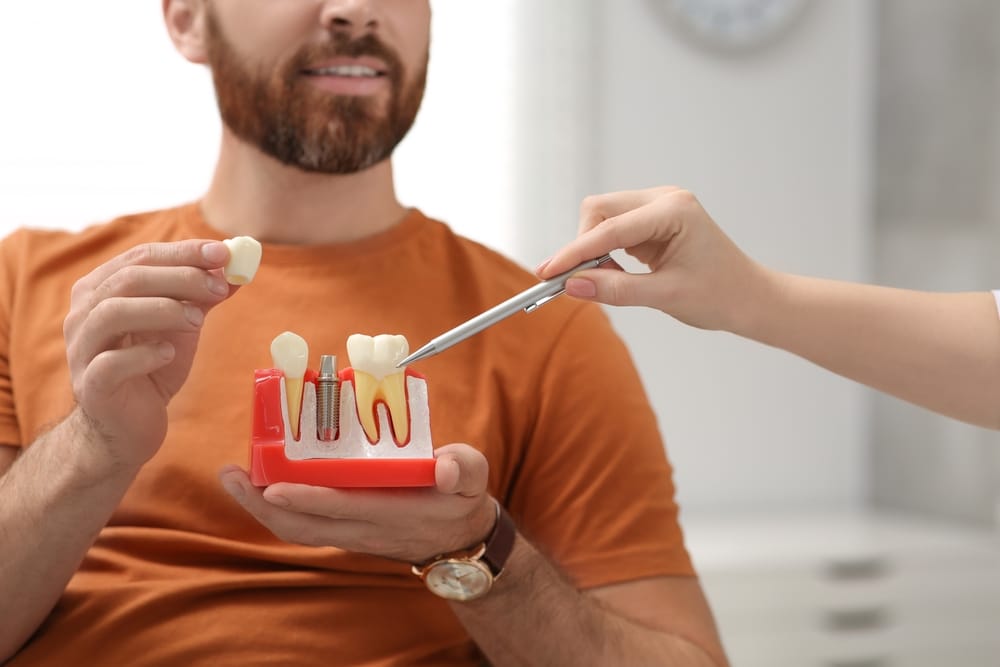
The metal post at the core of a dental implant procedure is roughly the size of a small screw, yet its impact on long-term oral health is significant. Once surgically placed into the jawbone, the titanium surface triggers a biological response where bone cells attach to and grow around the post in a process called osseointegration. Over three to six months, the post stops being a foreign object and becomes a structural part of your jaw, as load-bearing as any natural tooth root.
That anchored foundation is what separates implant dentistry from every surface-level alternative. A bridge sits above the gumline and relies on adjacent teeth for support; a denture rests on soft tissue that shifts over time. A dental implant restoration, by contrast, is embedded in bone, which is why it can carry full chewing force, stay fixed during speech, and remain stable for decades without the adjustments or replacements that other missing teeth solutions require.
Benefits of Dental Implants
Eat Without Restrictions
Slipping dentures or gaps left by missing teeth often force people to avoid certain foods like hard vegetables, crusty bread, and tough proteins. Because a dental implant fuses directly to your jawbone, the biting force is nearly identical to a natural tooth. You can chew with full confidence without worrying that your restoration will shift, pop loose, or create pressure points on your gums.
No Grinding Down Healthy Teeth
Traditional bridges need anchor teeth on either side of the gap, which means permanently reshaping otherwise healthy enamel to accommodate crowns. Dental implants stand entirely on their own. Adjacent teeth stay intact and untouched, preserving your natural tooth structure for the long term and making routine cleaning simpler since regular floss works with no special threaders needed.
Jawbone Stays Strong Over Time
Every time a natural tooth root moves during chewing, it signals your jawbone to maintain its density. When that root disappears, the bone begins to resorb. Dental implants replicate that stimulation, keeping the bone active and preventing the facial hollowing that often develops years after tooth loss. This structural preservation keeps your facial contours looking natural rather than sunken.
Long-Term Value Over Repeated Repairs
Bridges typically require replacement every 10 to 15 years; dentures need periodic relining and adjustments. A well-placed dental implant, maintained with regular dental checkups and daily hygiene, can last 25 years or longer. That longevity translates to fewer procedures over time and, in most cases, a lower total investment than repeated dental appliance replacements.
Stable Speech and Daily Comfort
Removable appliances can shift during conversation, creating clicking sounds or slurring. Dental implant restorations are fixed in place and require no adhesives, making natural speech effortless. Day-to-day comfort improves as well since there are no pressure sores from ill-fitting bases and no nightly removal routine. For patients who found conventional dentures intolerable due to poor ridges or a sensitive gag reflex, implants are often the first solution that truly works.
Our Dental Implant Treatment Process
Why Choose Us for Dental for Implants
Implant placement requires surgical precision, restorative skill, and the ability to manage the full scope of care including extractions and bone grafts without sending patients to multiple offices. Ocean Valley Dental handles all of that under one roof. The CBCT scanner guides safer surgery by removing the guesswork from nerve and sinus proximity, while 3D-printed surgical guides improve placement accuracy beyond what freehand technique allows.
Maintaining implants long-term depends heavily on gum health, which is why the practice employs five hygienists trained specifically in periodontal care and equipped with diode laser technology for treating inflammation around implant sites. That built-in maintenance team means your dental implant services include the monitoring and upkeep that protect your investment over the years, not just the procedure itself.

Reclaim What Tooth Loss Took with Dental Implants in Laguna Niguel, CA!
Every month a missing tooth goes unreplaced, the jawbone underneath continues to shrink and that window for straightforward implant placement narrows. Dr. Robert F. Murray, DDS at Ocean Valley Dental can assess your current bone structure and outline your options before that changes. Reach our team at 949-831-4655 to set up your consultation, or head to our Facebook page where real patient experiences speak for themselves.
FAQs
How do dental implants compare to dentures for everyday use?
Dental implants are fixed in place, while dentures rest on the gumline and can shift during meals or conversation. Because implants function like natural tooth roots, there are no adhesives, no removal routines, and no dietary restrictions to work around. For patients who found conventional dentures uncomfortable due to poor ridges or a sensitive gag reflex, implant dentistry is often the first solution that genuinely fits their lifestyle.
What happens to your jawbone when a tooth goes missing?
When a tooth root is no longer present, the jawbone in that area begins to resorb, losing density and volume over time. This gradual bone loss can alter your facial contours, making the area appear sunken or aged. A dental implant restoration is the only missing teeth solution that replicates the stimulation a natural root provides, keeping the bone active and structurally intact.
Is there an age limit for getting dental implants?
Dental implants are generally suitable for adults of any age, provided the jawbone has finished developing, which typically happens in the late teens or early twenties. Older patients are excellent candidates, and the dental implant procedure is successfully performed on patients well into their nineties. What matters most is bone density, gum health, and overall medical history, not the number on your birth certificate.
Can a dental implant support more than one missing tooth?
A single implant can anchor an individual crown, but implant dentistry also supports multi-tooth restorations. Two or more titanium posts can serve as the foundation for a fixed bridge, eliminating the need to grind down adjacent healthy teeth. For patients missing most or all of their teeth, a series of strategically placed implants can support a full arch dental implant restoration that functions far more stably than traditional dentures.
How soon after a tooth extraction can an implant be placed?
In some cases, a dental implant can be placed immediately after extraction during the same appointment, a technique that reduces overall treatment time. In others, the site needs several weeks to heal before the titanium post can be positioned correctly. During your consultation, your bone structure and extraction site will be evaluated to determine which approach gives your implant the best chance of long-term success.