

Invisalign (Clear Aligners)

You’ve probably caught yourself covering your mouth when you laugh or keeping your lips closed in photos, not because you’re shy, but because your teeth haven’t felt like something worth showing off. It’s a small habit that quietly chips away at your confidence, and a lot of people just learn to live with it.

At Ocean Valley Dental, Dr. Robert F. Murray, DDS sees this more often than you’d think, and the good news is that straightening your teeth no longer means signing up for two years of metal brackets and tightening appointments. Clear aligners are designed for exactly this situation, a discreet, flexible option that works around your schedule, your diet, and your life.

Request Appointment

Dentist Aliso Viejo

Are your teeth a good candidate for clear aligners?

Clear aligners work well for a wide range of orthodontic concerns. Mild to moderate crowding, gaps between teeth, and certain bite issues like overbites and underbites can all be addressed with this type of treatment. If your teeth are only slightly out of position, you may need fewer trays and a shorter overall timeline. More involved cases with significant crowding or complex bite problems may still be treatable with clear aligners, though some situations are better handled with traditional braces.

Candidacy also comes down to commitment. Clear aligners need to be worn 20 to 22 hours a day to move teeth on schedule. If they’re regularly left out for extended periods, teeth won’t track as planned and treatment stalls. They’re a strong option for people who can stick to a consistent routine, not because they’re difficult to wear, but because the results are directly tied to how reliably you wear them.

Benefits of Invisalign

No One at the Office Will Know You're in Treatment

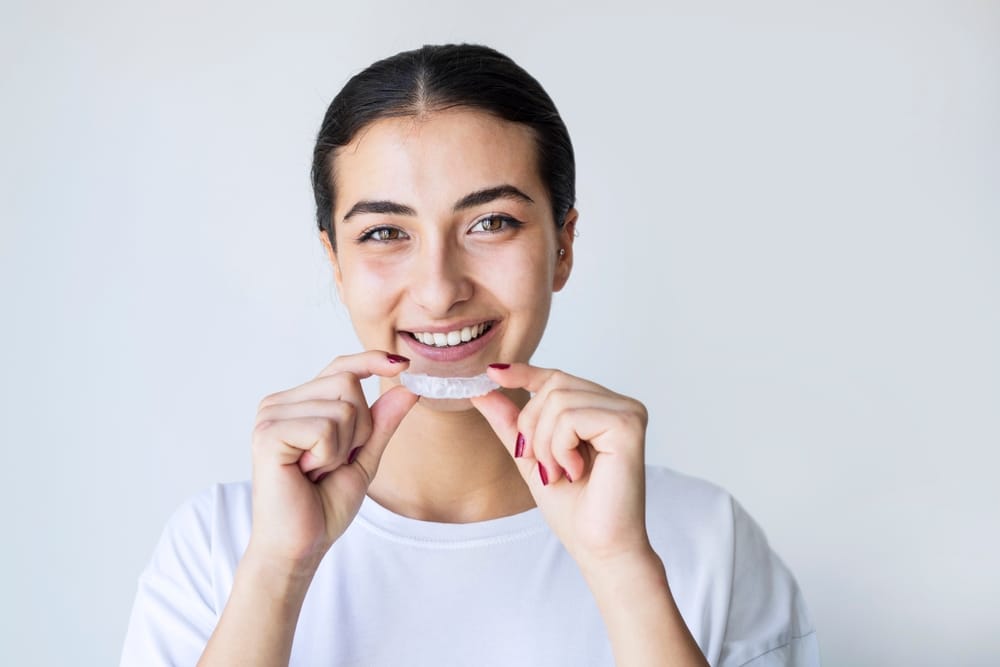
Clear aligners are made from transparent plastic that sits flush against your teeth, making them nearly undetectable during normal conversation or at work. Unlike metal braces, they don’t catch the light or draw attention when you speak. This matters especially for professionals and adults who want to improve their smile without it becoming a talking point at every meeting or social event.

Your Diet Stays Completely Unchanged

One of the most practical advantages of clear aligners is that you simply take them out before eating. There are no brackets to worry about breaking and no food restrictions to follow. Popcorn, apples, hard candy, none of it is off the table. You put the aligners back in when you’re done, and that’s it.

Brushing and Flossing Remain Straightforward

With traditional braces, cleaning your teeth properly requires special floss threaders, interdental brushes, and extra time at the sink. Clear aligners eliminate that entirely. You remove the trays, brush and floss as usual, and then clean the aligners before putting them back in. This ease of hygiene helps protect against the cavities and gum irritation that can sometimes develop around orthodontic hardware.

Less Unexpected Discomfort Between Appointments

Metal braces often cause soreness after adjustment appointments when wires are tightened. With clear aligners, the pressure is more gradual and distributed across the tray. When you switch to a new set, you might feel mild tightness for a day or so, but it usually fades quickly. There are no sharp wire ends to irritate your cheeks and no emergency visits for broken brackets.

You Can See Your Results Before Treatment Even Starts

Digital treatment planning gives you a preview of how your teeth will move at each stage and what your smile will look like at the end. You won’t have to wonder whether treatment is worth it because you’ll see the projected outcome upfront. This also means your appointment schedule and estimated completion date are established early, so you can plan around important events like weddings, graduations, or job interviews.

Why Choose Us for Your Clear Aligner Treatment

Ocean Valley Dental brings together clinical orthodontic experience, in-house lab capabilities, and Cone Beam Computed Tomography (CBCT) imaging to handle clear aligner cases with a level of precision that direct-to-consumer products simply can’t replicate. CBCT gives a three-dimensional view of your teeth, roots, and jaw structure, not just a surface-level scan, which leads to more accurate treatment planning from the start.

What also sets this practice apart is the honest approach to treatment recommendations. Dr. Murray has experience with both traditional braces and clear aligners, which means the recommendation you receive is based on what will actually work best for your teeth, not what’s most convenient or trendy. Patients who’ve gone through treatment here appreciate knowing the option they chose was the right one for their situation, not just the easiest sell.

Find Out What’s Actually Possible for Your Teeth!

A consultation with Dr. Robert F. Murray, DDS gives you something most people don’t expect: a straight answer about whether clear aligners will actually work for your teeth, what the process looks like for your specific case, and a realistic timeline before you commit to anything. If you’ve been putting this off, that conversation is the most useful first step you can take. A quick call to 949-831-4655 puts you directly in touch with Dr. Murray’s team, and if real patient results are what you need to feel confident first, those are waiting for you on our Facebook page.

Request Appointment

Dentist Aliso Viejo

FAQs

How much is Invisalign?

Invisalign costs typically range from $3,000 to $8,000, depending on case complexity and how many trays are needed. Mild corrections generally fall on the lower end, while comprehensive treatment runs higher. Many dental insurance plans that cover orthodontics apply to clear aligners, and most practices offer financing options. A consultation is the best way to get an accurate estimate specific to your teeth.

How does Invisalign work?

Invisalign uses a series of custom-fit, removable plastic trays that apply gentle pressure to shift teeth into alignment gradually. Each tray moves teeth a small amount, and you switch to the next set roughly every two weeks. The full sequence is mapped out digitally before treatment begins, so every movement is planned and controlled from start to finish rather than adjusted as you go.

How long does Invisalign take?

Invisalign treatment typically takes 12 to 18 months, though minor corrections can wrap up in as little as 6 months and complex cases may take longer. Consistent wear, 20 to 22 hours daily, is the single biggest factor in staying on schedule. Patients who build a reliable routine around wearing their aligners tend to finish closer to their original estimated timeline.

Can Invisalign fix overbite?

Yes, Invisalign can correct mild to moderate overbites, often using small attachments bonded to teeth that help the trays apply more precise pressure. Severe overbites may still require traditional braces or a combination of treatments for full correction. Whether clear aligners are sufficient depends on the degree of the bite discrepancy, which is assessed during a clinical exam.

Does Invisalign hurt?

Invisalign is generally less painful than traditional braces. Most people experience mild pressure or tightness when switching to a new set of trays, which typically eases within one to two days. Since there are no metal wires or brackets involved, the common irritations associated with conventional braces, like poking wires or broken hardware, are not a concern with clear aligner treatment.